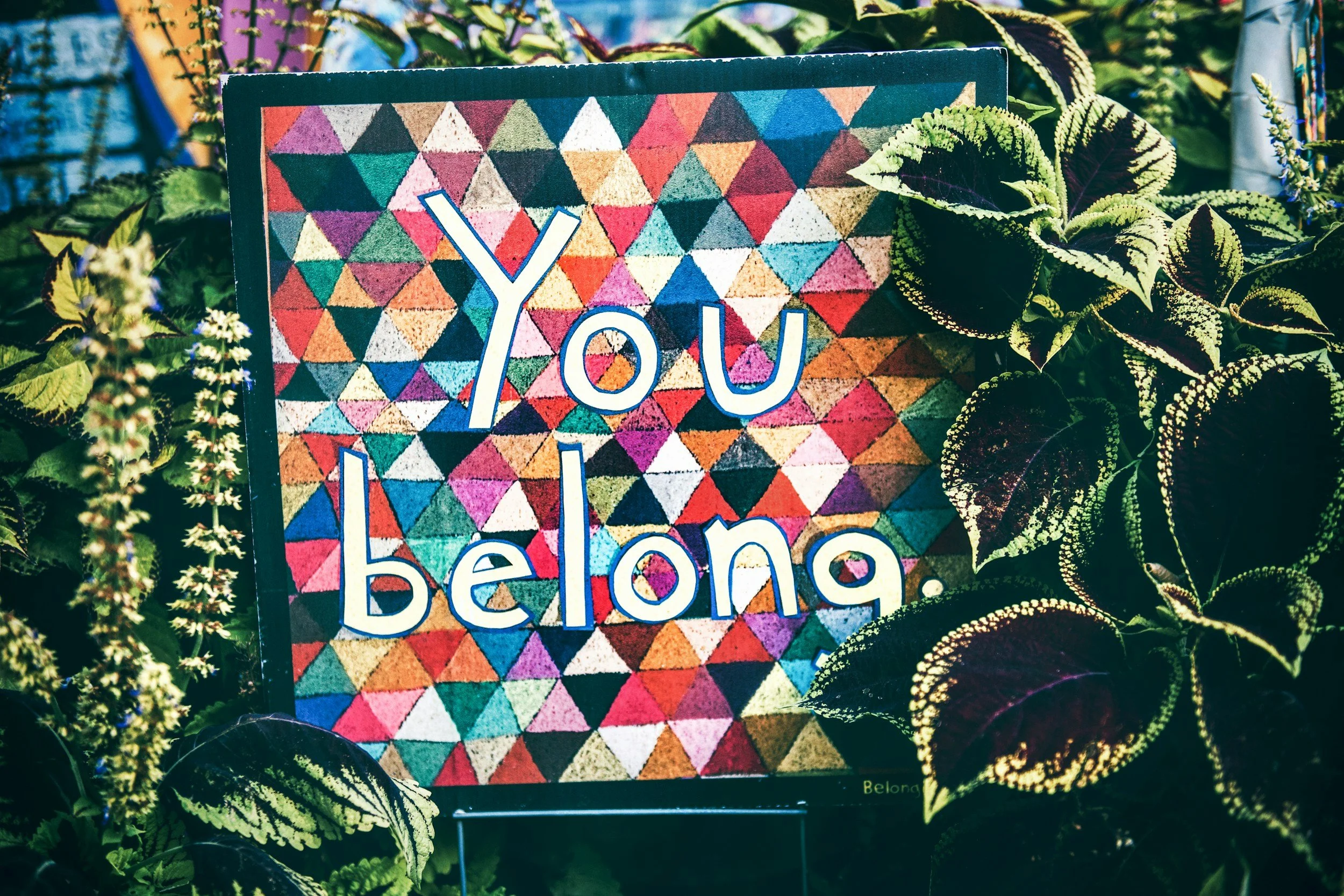
Therapy is never neutral, and neither am I.
Every therapist brings their values into the room whether they name them or not. I'd rather name mine so you know what you're walking into before you get here.
I am a humanistic therapist.
Which means I believe in the fundamental worth and dignity of every human being—not as a therapeutic stance I adopt in session, but as a core conviction I've held my entire adult life. I don't pathologize; I don't diagnose you; I don't reduce your experience to a label that makes it easier to categorize and harder to understand.
I believe you are doing the best you can with what you have. I believe the ways you've coped, the choices that look messy from the outside, the version of yourself you're not proud of — all of it made sense at the time. We start there, without judgment.
I am a feminist therapist.
Which means I understand that many of the things women bring to therapy are impacted by the consequences of living in a world that has demanded their smallness, their compliance, control of their body, their endless availability to everyone else's needs, and more.
The anxiety, the exhaustion, the inability to say no, the chronic self-erasure, the rage that arrives without warning and then gets suppressed because rage is not ladylike — these are not pathology. They are the residue of a lifetime of being systematically devalued. I don't treat that as a symptom to be managed. I treat it as information about what needs to change.
I don't stay neutral on human issues. I have opinions. I share them when it's useful. I believe in women's full autonomy over their bodies, their choices, their lives.
I am a strong LGBTQ+ ally.
I work with women across the full spectrum of sexual orientation and gender identity. I work with women in non-traditional relationship structures — non-monogamous relationships, polyamorous relationships, open relationships. I don't treat these as problems to be explored or lifestyle choices that require justification. They are simply part of who you are. We work from there.
If you have spent time in therapy with someone who treated your identity or your relationship structure as the presenting problem, or who maintained a carefully neutral stance that felt more like quiet disapproval — this is a different space.
I am not religiously oriented.
My framework is humanistically and depth oriented — rooted in Jungian psychology, existential philosophy, and the wisdom of the soma and psyche. I hold space for spirituality in the broadest sense — the sacred, the symbolic, the numinous, the transpersonal. But I don't work from a religious framework and I don't bring one into the room.
If you have felt pressured in therapy — explicitly or implicitly — to frame your experience through a religious lens that doesn't fit you, or if you've struggled to find a therapist who isn't operating from a Christian or otherwise religiously-oriented worldview, or if you have experienced religious trauma, you are not alone. And you are in the right place.
I am culturally informed.
I was raised in an Italian Catholic family, with deep Chicago roots. My family was loud and close and present in each other's lives. I have lived in the deep South for much of my adult life. Too often I have witnessed other therapists label family systems as dysfunction — instead of understanding it as culture, as famiglia. The difference matters enormously.
That experience shaped how I work. I don't apply a white, Northern European, individualistic framework to every person who walks into my practice and call it clinical objectivity. I try — imperfectly, and I will get it wrong sometimes — to understand the cultural context a woman carries with her. The family structure that looks dysfunctional to one set of eyes and looks like love to another. The collectivist values that look like codependency through a Western clinical lens. The ways that women of color, immigrants, and women from non-dominant cultural backgrounds have been disproportionately pathologized by a mental health system that was not built with them in mind.
I am not a specialist in every culture and I won't pretend otherwise. But I am someone who has sat with women from many different backgrounds, who takes cultural context seriously as clinical information, and who understands that what looks like a symptom is sometimes just a different way of being in the world.
If you have been in therapy with someone who missed who you actually are because of where you come from, how you were raised, what your family culture has been — you deserve better than that. This is a practice where we start with the full picture of who you are, not just the parts that fit neatly into a Western psychological framework.
I am not a neutral, blank-screen therapist.
I have a point of view. I have a sense of humor. I will say the thing out loud when it needs to be said. I will push back, gently and directly, when something isn't serving you. I will not act as if I am therapeutically neutral while you act as if everything is fine.
Real human connection is where change happens. I'm not interested in anything less than that.